One-to-One vs Small Group Personal Training in St Kilda: Benefits and Costs
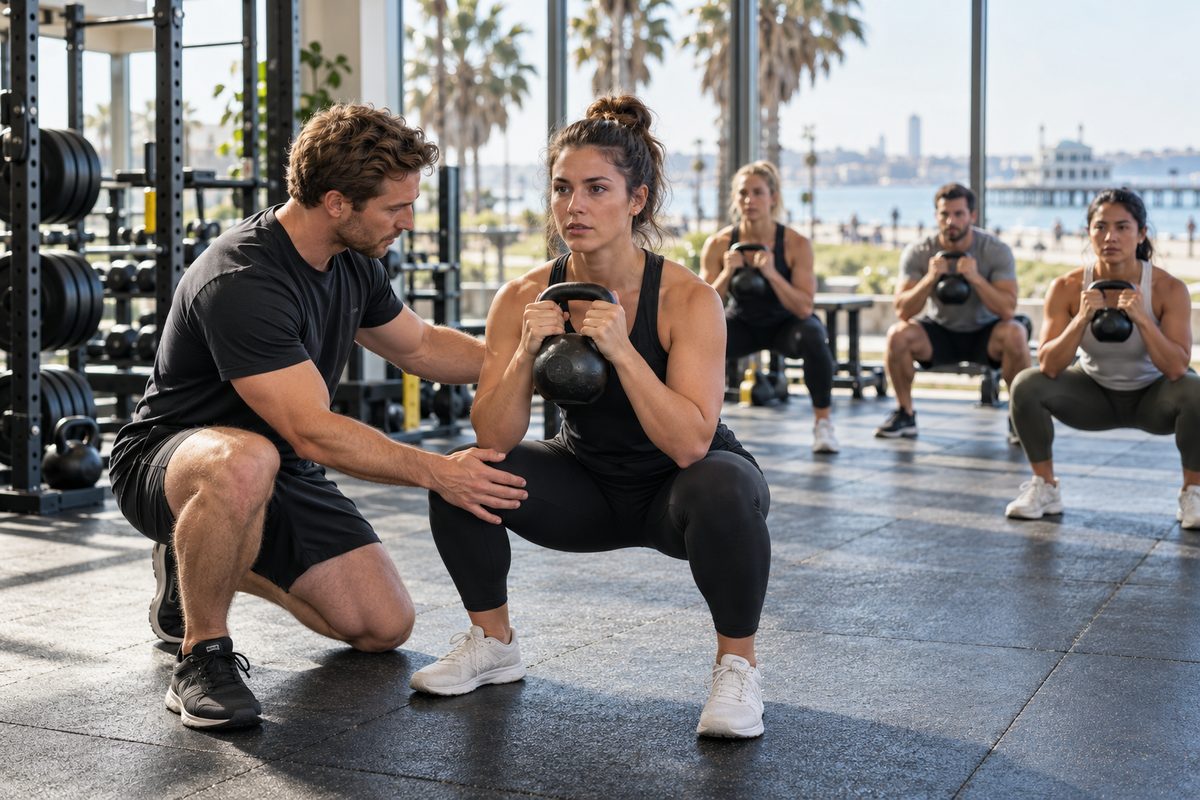
Choose one-to-one training if you are new, injured, or chasing a specific result; choose small group training if you already know the basics and want lower prices with built-in company. The gap is real. One-to-one sessions in St Kilda usually run about $90 to $130 for an hour. Small group sessions usually run about $30 to $55 per person. What you pay for is attention, and attention decides how fast you improve.
This guide compares the two formats on cost, coaching quality, results and fit. It does not repeat a full price breakdown for the suburb. It helps you decide which format deserves your money.
What actually differs between the two formats?
Only one thing changes: how many people share the coach. Everything else follows from that.
In a one-to-one session, your personal trainer watches every rep you do. They change the weight, the tempo and the exercise on the spot. The whole hour is built around your body and your history.
In a small group, usually three to six people, the coach runs one plan with small tweaks. A good coach still corrects form and offers easier or harder versions. But the attention is split, so each person gets a fraction of it.
Big classes with fifteen or twenty people are a different product. This article covers small groups only, because the coach can still see everyone.
How much does each format cost over a month?
Monthly cost matters more than the hourly rate, because it decides whether you can keep going.
- One-to-one, twice a week at about $105 a session: roughly $840 a month.
- Small group, twice a week at about $40 a session: roughly $320 a month.
- Small group, three times a week: roughly $480 a month, still well below two private sessions.
That last line is the key point. For the price of two private sessions, you can often train in a small group three or four times a week. More sessions means more practice, and practice builds physical fitness faster than a single perfect session.
Prices in St Kilda, Victoria sit close to the rest of Melbourne, with a small premium near the beachfront. Always ask for the per-session price after any package discount, and ask what happens when you cancel.
What do you get from one-to-one training that a group cannot give you?
You get three things a group cannot match: custom programming, instant correction and flexible scheduling. Wait, that is only part of it. The biggest gain is speed of learning.
When I coach a beginner one-to-one, I fix a squat in the first rep. In a group, I might reach that person on rep eight, after they have practised the fault seven times. Bad habits set fast.
One of my clients, a 34-year-old who worked in an office near Acland Street, had a lower back that tightened every time she deadlifted. In private sessions we found her hips were rotating early. We changed her stance and cut the load for three weeks. The pain stopped, and she then lifted more than she had before. A group setting would likely have missed it.
One-to-one also suits you if you have:
- An old injury or a current niggle that needs working around.
- A clear, narrow goal with a deadline, such as a wedding or a surgery date.
- A tight or unusual schedule that a group timetable cannot meet.
- Nerves about training in front of others.
What do small groups do better than private sessions?
Small groups win on price, energy and consistency. People underrate the last one.
I know this because of what happened with a client who kept cancelling private sessions. She paid for them, so the money was not the issue. The issue was that nobody noticed when she skipped. When she moved into a Tuesday and Thursday group at the park, two other members texted her when she was late. She did not miss a session for four months.
That is motivation working through other people. You show up because someone expects you. The shared effort also makes hard sets feel shorter. Many people push harder next to a stranger than they would alone.
Groups also cost less, which lets you train more often. And they feel less formal, so people who dislike one-on-one attention often relax faster.
Which format builds muscle and strength faster?
Neither format wins by magic. Results come from progressive overload, which means gradually asking your body to do slightly more over time: more weight, more reps or better control. The format only matters if it helps you do that consistently and safely.
For muscle hypertrophy, the growth of muscle size, you need hard sets taken close to failure, repeated across weeks, with enough protein and sleep. A private coach can choose the exact load that makes each set hard but safe, and can record every number. That precision helps most in the first six months, when technique is still forming.
A small group can deliver the same overload if the coach tracks each person's weights. Ask any group trainer one question: "How will you know what I lifted last week?" If they have no log, you are being guided by feel, and progress will stall.
In my experience, a beginner gets the best return from a short run of private sessions to learn the main lifts, then moves to a group to keep the volume high. Experienced lifters often do well in groups from day one because they already know how to push.
Which one suits your goal?
Match the format to the job you are hiring it to do.
- Fat loss and general health: a small group works well. You need frequency and routine more than perfect technique.
- Learning to lift: start one-to-one for a month or two, then reassess.
- Building visible muscle: one-to-one early on, then a mix. Progress depends on heavy, well-executed lifts.
- Rehab or return from injury: one-to-one, with your physio's input where possible.
- Accountability and social contact: small group, almost always.
Your life outside the gym matters too. A parent with two free hours a week should probably spend them in private sessions that make every minute count. Someone who can train five days a week gets more from the cheaper group format.
Is the location part of the decision?
Yes, because convenience decides whether you keep turning up. Many people in the area train near the foreshore, around Albert Park, Victoria, or close to the lake path, and others prefer a studio a short walk from home. Groups often meet at set outdoor spots, which suits a morning run-and-lift routine. Private sessions can move to wherever your week takes you.
Work out the door-to-door time. A cheap group you dread travelling to costs more than a pricier session around the corner, because you will stop going.
What should you check before you sign up?
Ask these questions before you pay for either format.
- What is the maximum group size, and is it capped?
- Does the coach record my weights and reps each session?
- Who plans my program, and how often do you change it?
- What qualifications and insurance does the coach hold?
- What is the cancellation rule, and can I trial one session first?
Skip any trainer who dodges these. A clear answer to each tells you the coach runs a real system and not just a good-looking workout.
Can you combine both formats?
You can, and for many people it is the best value. Train in a group two or three times a week for volume and company, then book one private session every two weeks. The private session fixes technique, updates the plan and sets the next target.
One of my clients did exactly this. He trained in a group on Monday and Thursday and saw me alone every second Saturday. His monthly spend was about $400 instead of $840. In six months his squat went up by 25 kilograms, because the private sessions kept his form clean while the group sessions gave him the repetitions.
This hybrid also covers the weak point of each format. The group fixes the motivation gap. The private session fixes the attention gap.
When is each format a poor choice?
One-to-one is a poor choice if the cost forces you to train only once a week. One session a week rarely builds enough physical fitness to change your body. You would do better in a group three times.
A small group is a poor choice if you have a significant injury, a medical condition, or a movement problem you cannot yet control. Pain during a set in a group can go unnoticed. Start privately, get cleared to train normally, then join the group.
Also avoid groups that quietly grow. A "small group" that reaches twelve people is a class with a nice name.
Your next step
Pick the format by answering two questions: how many days a week can you afford to train, and how sure are you of your technique? If you can train three or more days and you know the basics, start with a small group. If you are new or hurting, book two to four private sessions first, then move to a group or a mix.
Then book a trial session in each format with a local coach, such as the team at St Kilda Personal Trainers, and ask the five questions above. After one week you will know which room you want to walk back into.