Personal Training for Weight Loss in St Kilda: Building a Sustainable Routine
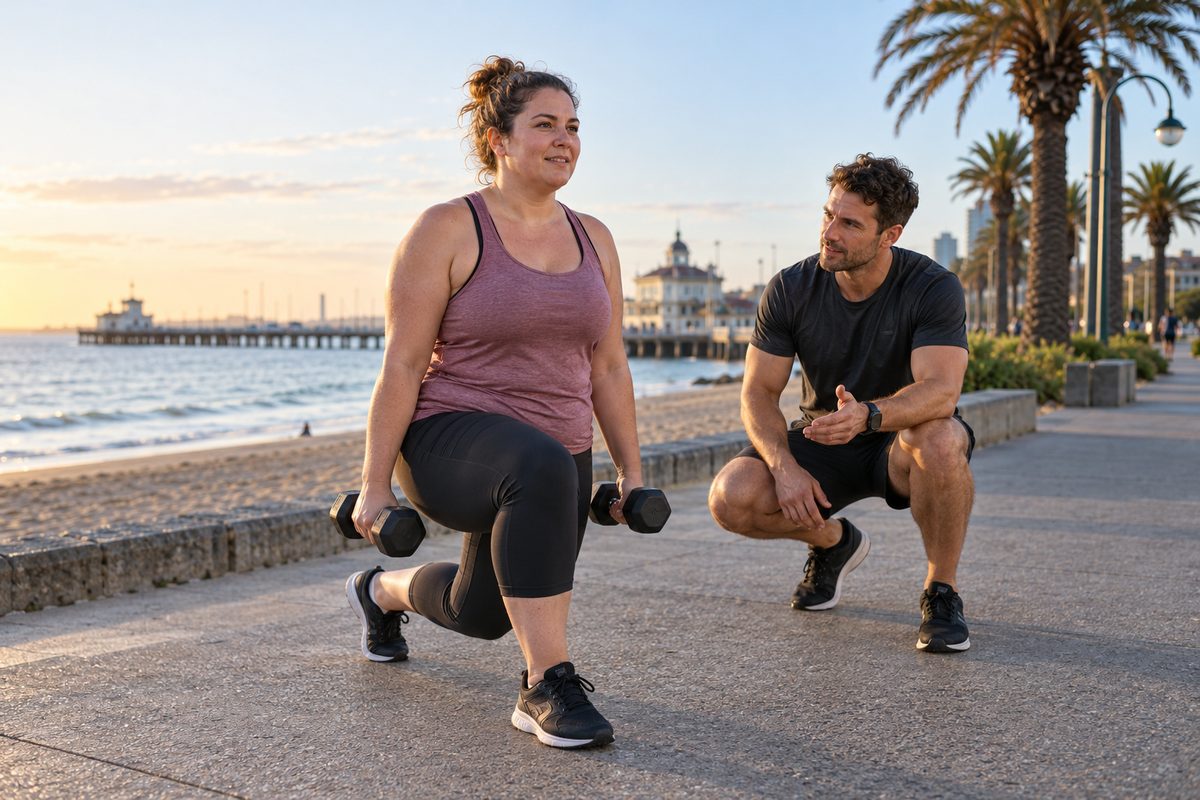
Personal training helps you lose weight when it builds a routine you can repeat for months, with two or three strength sessions a week, steady daily movement and food changes small enough to keep. Intensity gets people started. Repetition gets them results. A plan you drop in week five does less for you than a gentler plan you still follow in week fifty.
I have coached people in and around St Kilda, Victoria, for years. The pattern is the same almost every time. Someone arrives with a big goal, trains hard for a month, then quits when work gets busy. This article shows you how to avoid that cycle.
Why do most weight loss plans fall apart by week six?
They ask for too much, too soon. A new client of mine once booked five sessions a week, cut out most carbs and walked 15,000 steps a day. She lost four kilos in a month. Then she got a cold, missed a week and felt like she had failed. She stopped completely.
Nothing was wrong with her effort. The plan had no room for real life. That is the core problem with most weight loss programs. They treat motivation as endless, and it is not.
Sustainability is the real skill here. It means you can keep the plan going on a bad week, a travel week and a tired week. If your routine only works when everything goes right, it will break.
Here is a simple test. Ask yourself: could I do this schedule for the next six months? If the answer is no, shrink it until the answer is yes.
What does a sustainable training week look like?
For most beginners and returners, it looks smaller than they expect. Two or three sessions a week of about 45 minutes each, plus daily walking. That is it.
Here is a week I often start clients on:
- Monday: full body strength session with your personal trainer.
- Wednesday: a second strength session, either guided or on your own from a written plan.
- Saturday: a longer walk or a light jog by the water.
- Every other day: a short walk and ten minutes of mobility work.
A personal trainer earns their fee by keeping this structure tight. They stop you from adding extra sessions when you feel keen, because that keenness fades. I know this because I have watched it happen to my own clients and to me. When I tried to train six days a week early in my career, I burned out in two months.
Book your sessions at fixed times, the same days each week. A habit with a fixed slot survives. A habit that depends on finding time does not.
How does strength training protect your weight loss?
It tells your body to keep muscle while you lose fat. This is the most missed idea in weight loss. When you eat less and only do cardio, your body drops muscle along with fat. You get lighter on the scale but softer in the mirror, and your metabolism slows.
Strength training sends a different signal. Your body needs that muscle, so it holds onto it. The result is a change in body composition, which means the ratio of fat to muscle in your body. Two people can weigh the same and look very different because of this ratio.
One of my clients, a man in his forties, lost only two kilos over three months. He was upset. But his waist dropped by seven centimetres and his clothes fit loosely. He had swapped fat for muscle. The scale could not show it.
This is why I rarely let clients judge progress by weight alone. Muscle also improves your overall physical fitness. You climb stairs more easily, carry shopping without strain and sleep better. Those wins keep you motivated when the scale stalls.
Why does progressive overload matter for fat loss?
Because your body only changes when you give it a reason to. Progressive overload means you slowly ask for a little more over time. You add a bit of weight, one more repetition or an extra set.
If you lift the same weights for the same repetitions every week, your body adapts and stops changing. You are exercising, but you are not progressing.
The key word is slowly. Here is how I apply it:
- Pick a weight you can lift for ten clean repetitions with two left in reserve.
- Each week, try for one extra repetition on each set.
- When you reach twelve repetitions on every set, add a small amount of weight and drop back to ten.
This method feels almost too easy. That is the point. Small jumps keep your joints safe and your confidence high. In my experience, people who jump in weight too fast get sore, skip sessions and lose momentum. People who add tiny amounts keep showing up.
A trainer tracks these numbers for you. After twelve weeks, you can look back at a log and see you lift far more than when you began. That proof is powerful on days you feel stuck.
How much does daily movement matter?
More than most people think. Your gym sessions cover maybe three hours of your week. The other 160 or so waking and sleeping hours matter a lot for fat loss.
Non-exercise activity thermogenesis, often shortened to NEAT, is the energy you burn through everything that is not formal exercise. Walking to the tram, taking the stairs, cleaning, standing at your desk and fidgeting all count. For some people, NEAT burns hundreds of extra calories a day compared with someone who sits all day.
Here is the catch. When you diet hard, your body quietly cuts NEAT. You move less without noticing. You sit more, slouch more and feel tired. I see this in clients who say, "I am eating so little and not losing anything." Their daily movement had dropped by thousands of steps.
The fix is simple. Set a step floor, not a step ceiling. Pick a number you can hit even on a lazy day, such as 7,000 steps. Then track it. If you have been averaging 4,000, jump to 5,500 first, then build up over a few weeks.
St Kilda makes this easy. A walk along the foreshore, a loop of the pier or a stroll to a coffee shop all add up. You do not need a special workout. You need to stop sitting for hours at a time.
Should you eat very little to lose weight faster?
No. A very-low-calorie diet is a medically supervised approach that uses extremely low daily energy intake, usually under 800 calories. Doctors use it in specific cases, often for people with a high body weight who need rapid loss before surgery or for health reasons. It is not a tool for the average person who wants to feel better in their clothes.
For everyone else, eating this little is a trap. You lose muscle, your energy crashes, you get cravings and your training suffers. Strength sessions become impossible when you are underfed. Most people also regain the weight once they stop, because the diet was never a way of life.
One client tried a crash plan before a wedding. She dropped weight fast, then regained all of it plus extra within three months. When we rebuilt her approach with moderate portions and steady training, she lost slower but kept it off. She told me the slow way felt boring, and boring is what worked.
If you think you need rapid or medical weight loss, speak to your doctor first. A personal trainer can support you, but they should not prescribe extreme eating plans.
How should you eat while you train?
Keep it simple and aim for a modest deficit. A deficit of about 300 to 500 calories below your usual intake works for most people. It is small enough to keep training hard and large enough to move fat loss along.
Three habits do most of the work:
- Eat protein at every meal to support muscle and keep you full.
- Fill half your plate with vegetables most days.
- Keep the foods you love, in smaller or less frequent amounts.
That last point matters more than it sounds. When I tell clients they can still have pizza on Friday, their stress drops and their consistency rises. Banned foods become obsession foods. Allowed foods become normal foods.
Do not overhaul everything at once. Pick one change this week, such as adding protein to breakfast. Add the next change in two weeks. Slow stacking beats a dramatic reset.
Where should you train around St Kilda?
Train where you will actually show up. For some people, that is a local gym close to home. For others, it is outdoors. The best setting is the one with the fewest obstacles between you and the session.
Many of my clients mix indoor strength work with outdoor movement. A session in the gym builds the lifts. A walk or easy run through Albert Park, Victoria, around the lake adds low-stress cardio and daily steps. The flat path is kind to beginners, and the scenery makes it feel less like a chore.
Weather is a real factor on this coast. Wind off the bay can turn a planned beach session into a grind. Have a wet-weather plan ready, such as a shorter indoor session. A plan with a backup keeps the week alive when conditions change.
How do you know the routine is working?
Track more than one number. Weight is useful, but it swings with water, salt and sleep. If you only watch the scale, you will panic over noise.
Use a small set of measures instead:
- Waist measurement once every two weeks.
- Your strength log, showing weights and repetitions.
- Average daily steps.
- How your clothes fit and how you feel.
Give any new routine at least eight to twelve weeks before you judge it. Most of what you will see in the first month is your body adjusting. Real change in body composition tends to show from week six onward.
If progress stalls for three weeks in a row, change one thing, not five. Adjust food intake slightly, raise your steps or add a set to your main lifts. Then wait another two weeks. Constant tinkering hides what is working.
What does a personal trainer add to this?
Three things you struggle to supply yourself: structure, accountability and honest feedback. Structure means someone has designed your week around your life. Accountability means a person is waiting for you on Monday morning. Feedback means someone catches the form errors and the plateaus you cannot see.
I know this because one of my clients trained alone for two years with little change. Within four months of regular coached sessions, she lifted nearly double her old weights. Her effort had not changed. Her plan had.
A good trainer also protects you from yourself. They will tell you to rest when you want to overtrain and to eat more when you want to cut too hard. That kind of pushback is what keeps a routine going for years.
Ask any trainer how they would handle a missed week. The answer tells you if they build plans for real life. You want a coach who says, "We restart on Monday," not one who says, "You need to make it up."
Your next steps
Start small and stay with it. Use this order:
- Pick two fixed training days and write them in your calendar today.
- Set a realistic daily step floor and track it for one week.
- Choose one food change, such as protein at breakfast, and hold it for two weeks.
- Log every strength session, and add one repetition or a small amount of weight when you can.
- Book a session with a local trainer who can build the plan around your schedule. Start with St Kilda Personal Trainers to see how a sustainable program is set up.
Weight loss is a long game, and the winner is the person who is still training next year. Build the routine you can keep, and the results follow.