Personal Training in St Kilda: How to Choose the Right Trainer for Your Goals
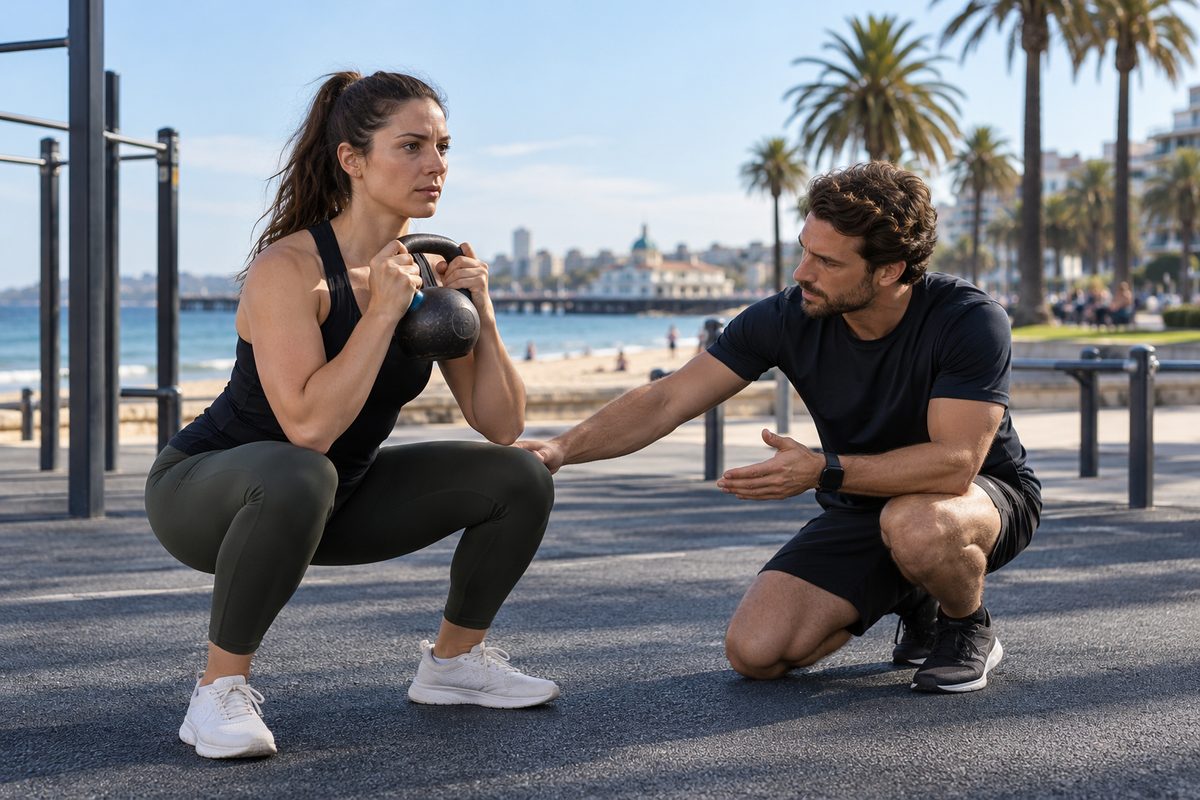
Choose the trainer whose qualifications, insurance and programming method match your specific goal, then test the fit with one paid session before you commit to a block. Most people do the opposite. They pick the closest studio or the nicest Instagram feed and hope. That's how people end up paying for months of sessions that feel busy but change nothing.
This guide gives you a simple filter. It works for anyone searching for a trainer in St Kilda, Victoria. Maybe you want to lose fat, build muscle, rehab an old injury or just stop feeling flat by 3pm.
What should a trainer prove before you book?
Three things are on the table, and you should ask for them in writing: a current qualification, current first aid, and current insurance.
Start with the qualification. In Australia, a Certificate III and IV in Fitness is the standard entry point. Many good trainers hold more, such as a degree in exercise science. Ask which course they finished and when.
Then ask whether they're registered with Fitness Australia or a similar body. Registration isn't magic. But it shows they keep their skills fresh and follow a code of conduct.
Next, ask about first aid. A trainer should hold a current first aid certificate and a CPR certificate. You'll be lifting heavy things and pushing your heart rate up. If something goes wrong, you want the person next to you to know exactly what to do in the first sixty seconds.
Then ask about insurance. Specifically, ask whether they carry professional liability insurance. This covers claims if a client is hurt because of their advice or programming.
A trainer who works in a gym often sits under the gym's policy. A trainer who runs sessions in a park or at your home needs their own. If they can't show you a certificate, walk away. In my experience, the trainers who get defensive about this question are the ones you least want to train with.
How do you match a trainer to your goal?
Every trainer can say they do "everything." Few actually do. Pick your goal first, then look for the trainer whose daily work matches it.
Fat loss and body composition
If you want to change your body composition, you need a trainer who talks about more than the scale. Body composition is the split between fat and muscle in your body. Two people can weigh the same and look completely different.
A good trainer tracks measurements, photos and strength numbers alongside weight.
One of my clients came in wanting to "lose six kilos." She'd dropped five on a crash diet the year before and gained it all back. We shifted the target to keeping muscle while dropping fat. Her weight barely moved for six weeks. But her waist dropped four centimetres, and her squat went up. She stayed lean because the muscle stayed.
Building muscle
If you want size, ask how the trainer plans muscle hypertrophy. Hypertrophy is the growth of muscle fibre. It needs enough volume, enough effort close to failure, enough protein and enough sleep.
A trainer who builds your program around those four inputs knows the job. A trainer who hands you a random circuit each week doesn't.
Getting strong
Strength training is the base for almost every other goal. It protects joints, supports bone density and makes daily life easier. If strength is your priority, look for a trainer who teaches the squat, hinge, press and pull properly. They should also write down your numbers every session.
If they never write anything down, they can't tell whether you're improving.
General health and Physical fitness
If you simply want better physical fitness, you need a trainer who mixes strength work with some conditioning and mobility. They should also build a plan you can keep. Ask what a normal week looks like at month three. If the answer is vague, so is the plan.
Injury or pain history
If you have a bad shoulder, knee or back, tell the trainer on day one and watch what they do. A good one asks questions, may ask for a note from your physio, and changes the plan around your limits. A poor one says "we'll work through it."
What does a good program actually look like?
Look for one idea above all others: progressive overload. It means you slowly ask more of your body over time. You add a little weight, a rep, a set or better control. Your body adapts because it has a reason to.
Without it, you repeat the same workout and get the same body. I see this often. A new client tells me they trained twice a week for a year with another trainer and nothing changed.
When we pulled up the old sessions, they'd used the same 8 kilo dumbbells for twelve months. They were tired every session. They were never challenged in a way that built anything.
Here's how to test it. Ask the trainer how they decide when to increase your load. A strong answer sounds like this: "When you hit the top of the rep range with good form, we go up." A weak answer sounds like this: "We mix it up to keep your body guessing." Variety has a place. Guessing isn't a method.
Also ask how they handle a bad day. People sleep badly, get sick and have stressful weeks. A good trainer adjusts the session and keeps the long plan intact. A rigid trainer pushes through. A trainer with no plan cancels.
What should the first session feel like?
The first session should feel more like an interview than a workout. Expect questions about your history, your schedule, your injuries, your sleep and what you've tried before. Expect a movement check where the trainer watches you squat, hinge, push and pull. Expect a short workout at the end.
Red flags are easy to spot. If the trainer spends the hour trying to exhaust you, they're selling a feeling. If they push a large package before they know your goal, they're selling a plan written for someone else. If they never ask about your injuries, they're not paying attention.
Good signs are just as clear. They explain why you're doing each exercise. They correct your form calmly. They set a clear first target, such as a 12 week goal with a measurable number attached. And they ask for your feedback at the end.
When we start with a new client, I tell them to book one session only. That way the trainer has to earn the next one. If a studio won't let you try a single session, ask yourself why.
Does location matter in St Kilda?
Yes, but not for the reason most people think. The best location is the one you'll actually reach on a rainy Tuesday morning.
St Kilda is compact. Trainers and studios sit near Acland Street, along Fitzroy Street, Melbourne, and on the quieter side streets between them and the foreshore. If you live near the cafes of Acland Street, a studio around the corner removes an excuse. If you work on Fitzroy Street, a lunchtime session beats an evening one that gets cancelled by a late meeting.
Outdoor sessions by the beach are popular. They work well in good weather and for fitness basics. They're harder for heavy lifting because the equipment is limited. If your goal is strength, make sure the trainer has a plan for wet days and access to proper weights.
A quick note on searching. If you type a loose phrase such as "Bayside, Queens" into a search bar, you may land in New York, not here. Always add St Kilda to your search so you find local trainers and not a similarly named place on the other side of the world.
One more point on location: travelling trainers who come to your home or park save you commute time. Check their insurance covers that setting. Many only cover their own studio.
How do you spot a trainer who will not get you results?
Watch for these patterns.
- No written plan. If every session is improvised, you're paying for company, not coaching.
- Guaranteed results. Nobody controls your sleep, food or stress. A guarantee is a sales line.
- Extreme diets. A trainer who tells you to cut out entire food groups, or hands you a diet far below what you need, is outside a safe scope. Detailed meal plans for medical conditions belong with a dietitian.
- Constant upselling. Supplements, extra packs and add-ons in every session mean the business comes first, not your progress.
- No tracking. If nobody records your weights, reps or measurements, nobody can tell you whether it's working.
- Ego training. If the trainer's aim is to make you vomit or limp, they confuse pain with progress.
I know this because a client of mine came to me after six months with a trainer who ran her through burpees and sprints every session. She was exhausted and had lost no fat. Her knees hurt.
Within eight weeks of a structured strength plan, the knee pain eased and she could lift nearly her bodyweight on the leg press. The hard work was never the problem. The lack of direction was.
What should you pay, and how do you judge value?
Prices in Melbourne vary by studio, experience and format. One-on-one sessions cost more than small group training. Semi-private sessions, with two to four people sharing a trainer, often cost much less per person and still give you real coaching.
Don't choose on price alone. A cheap session that teaches nothing costs more than a pricier session that leaves you with a clear plan. Judge value this way: divide the cost by how much you learn and how consistently you show up. If you leave a session knowing exactly what to do next week, that's value.
Ask about the cancellation policy and what happens if you need to pause. Ask whether the package expires. Ask if you can train with a different coach if the fit is wrong. Good businesses answer these questions easily.
Do you need a trainer forever?
No. A good trainer works toward making you more independent. Many clients train with me for three to six months, learn how to lift and how to plan, and then check in monthly. Others stay long term because they like the accountability. Either path is fine. What matters is that the trainer is honest about it.
Ask your trainer on day one: "What does it look like when I no longer need you as often?" A confident trainer has a clear answer.
Your next steps
- Write your goal in one sentence. Include a measurable number and a time frame, such as "squat my bodyweight in 16 weeks" or "drop 5 centimetres from my waist in 12 weeks."
- Shortlist two or three St Kilda trainers. Pick those who work with goals like yours.
- Ask for proof. Request their qualification, current first aid certificate, Fitness Australia registration if they hold it, and a certificate of professional liability insurance.
- Book one session with each. Pay for one session only. Notice who asks questions, who tracks numbers and who explains progressive overload in plain words.
- Choose the trainer who gave you a clear plan. Then commit to eight weeks and judge the result with measurements, photos and strength numbers.
If you want to see how a local team handles this process, visit St Kilda Personal Trainers and book a first session. Bring your goal, ask the questions above, and hold the trainer to the answers.