Strength and Fitness After 50: a Guide to Personal Training in St Kilda
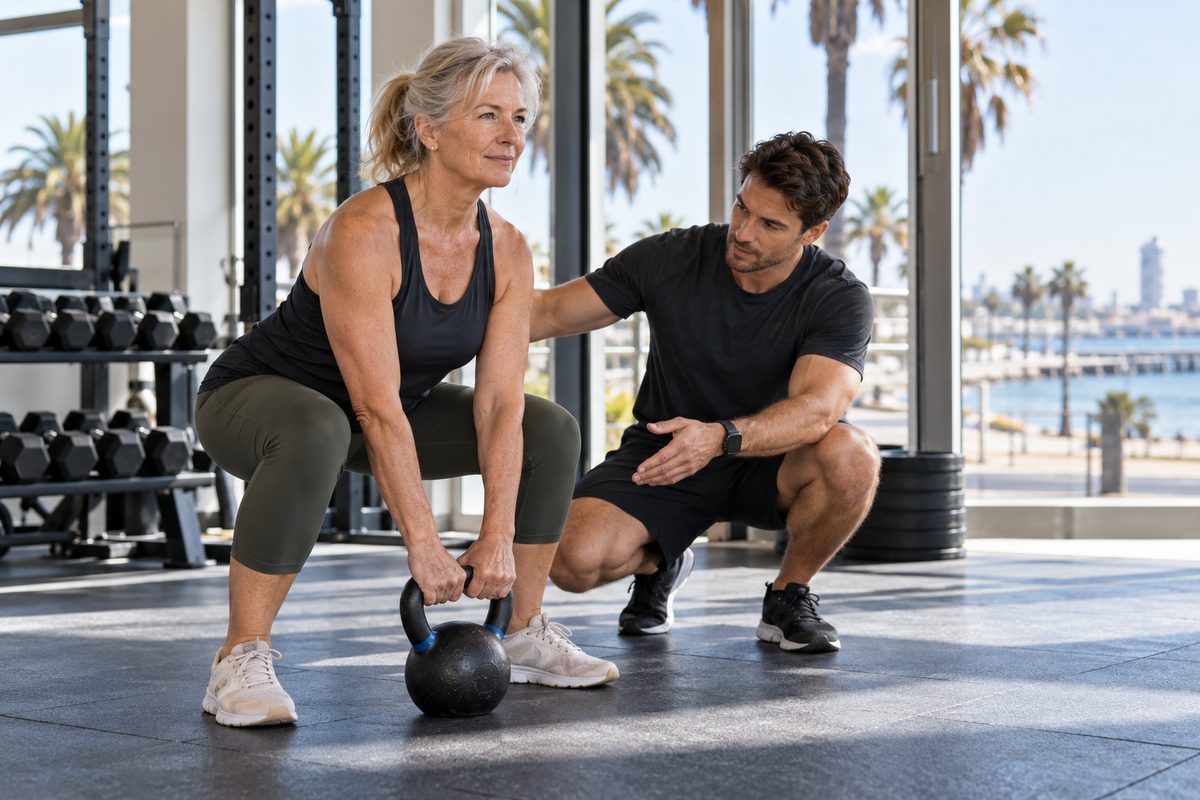
After 50, the most effective way to stay strong and fit is to lift heavy enough to challenge your muscles twice a week and pair it with regular aerobic work. A good personal trainer makes that safe, specific and sustainable. Your body still adapts at 55, 62 or 70. It just needs a clearer plan than it did at 30, and less guesswork.
This guide covers what changes after 50, what training answers each change, and how to judge a trainer in St Kilda, Victoria who works with your age group. If you want the basics of picking any trainer, or a beginner lifting plan, those topics are covered elsewhere on the site. Here the focus is on the over-50 body.
What actually changes in your body after 50?
Four things shift, and all four respond to training.
First, you lose muscle. Muscle atrophy starts quietly from your 30s and speeds up in your 50s and 60s. Without resistance work, adults can lose a noticeable share of muscle each decade. Less muscle means a slower metabolism, weaker legs and less power to get out of a low chair.
Second, your bones thin. Bone density drops faster in the years around menopause for women, and men lose it too, just later. Bone responds to load. If nothing pushes on it, it gets weaker.
Third, your heart and blood vessels become less forgiving. Cardiovascular disease risk climbs with age, and the circulatory system loses some of its flexibility. Blood pressure creeps up when you stay still.
Fourth, balance fades. Reaction time slows and leg strength drops. That combination is what makes a trip on a kerb turn into a fall.
None of this is a sentence. It is a list of jobs for your training program.
Why is lifting weights the priority and not walking?
Walking is good for you. It does not do enough to stop muscle loss or thin bones. Only resistance training gives muscle and bone a reason to rebuild.
One of my clients, a 58-year-old who walked the St Kilda foreshore every morning, came to me frustrated. She was fit enough to walk for an hour, but she struggled to carry her shopping up the stairs and her knees ached. Her legs had the endurance but not the strength. After eight weeks of squats, step-ups and rows, the stairs stopped bothering her. Her walks did not change. Her strength did.
Strength work also changes your body composition. The scale may barely move, yet you carry more muscle and less fat. That matters more than weight after 50, because muscle protects your joints, your blood sugar and your independence.
I know this because I see the same pattern again and again. People who add lifting to their walking feel the difference in daily life within two months.
How does progressive overload work when you are over 50?
Progressive overload means gradually asking your body to do slightly more than it did last time. More weight, more repetitions or better control all count. It is the single rule that drives results at any age.
The mistake I see in this age group is staying at the same light dumbbells for a year. Your muscles adapt to that weight and stop changing. Pink 2 kg weights will not rebuild muscle.
Here is how I apply it with clients over 50:
- Start with a weight you can lift 10 to 12 times with two good repetitions left in the tank.
- When you can finish all your sets with clean form, add a small amount of weight the next session.
- Take an easier week every fourth or fifth week so tendons and joints can catch up.
Joints and tendons recover slower than muscle does as we age. That is why the jumps stay small and the form stays strict. A trainer watches for the first sign of sloppy technique and adjusts before it becomes an injury.
Heavier loads are safe for most people when built up slowly. In my experience, clients are surprised how much they can lift once they stop being afraid of it. One of my clients, a 64-year-old man who thought deadlifts were for young people, was lifting 60 kg within three months. His back pain eased because his body finally had the strength to support itself.
What does lifting do for your bones?
Bone density responds to impact and heavy load. When a muscle pulls on a bone, the bone senses the stress and lays down more mineral. That is why loaded squats, deadlift variations, overhead presses and carries are so useful for the hips and spine, the two sites where fractures hurt most.
If you have been told you have low bone density, do not avoid lifting. Avoiding load is what weakens bone further. Instead, get your doctor's clearance and work with someone qualified to adjust exercises around your results. Some spinal movements need modification when bone is fragile, and a trainer who understands this will swap them without making you feel limited.
Where does aerobic work fit in?
Strength builds your frame. Aerobic exercise builds your engine. You need both.
Aerobic conditioning trains your heart to pump more blood per beat and helps your circulatory system deliver oxygen to working muscles. Over time it lowers resting heart rate and blood pressure, which cuts your cardiovascular disease risk. Australian physical activity guidelines suggest adults aim for at least 150 minutes of moderate activity each week, along with muscle-strengthening work on two days.
Moderate means you can talk but not sing. A brisk walk along the bay, a bike ride or a swim all qualify. Once a week, I like clients to try a short interval session, such as one minute faster and two minutes easier, repeated for 20 minutes. This kind of work improves heart fitness quickly, but only once your strength base is in place and your doctor has cleared it.
A caution I give to every new client: if you have chest pain, unexplained breathlessness or dizziness, stop and see your GP first. A decent trainer will ask about your heart history before you do your first set.
How do you train balance and fall prevention?
Fall prevention is not a separate topic from strength. It is a result of it. Strong legs catch you when you stumble. Strong hips keep you upright when the footpath tilts.
Core stability sits at the centre of this. Your core is more than visible abs. It is the group of muscles that keeps your spine steady while your arms and legs move. When it is weak, you wobble when you reach, turn or step off a kerb.
Good balance training for this age group includes:
- Single-leg stands and step-downs to build hip strength.
- Carries, where you hold a weight in one hand and walk, to challenge your trunk.
- Slow turning and reaching drills that copy real movements.
I know this because one of my clients, a 71-year-old woman, came after she slipped on wet pavers and broke her wrist. She was scared to walk outside. Six months of single-leg work and carries gave her enough control that she walks the beach path alone again. Her confidence returned before her wrist strength did.
What should a trainer in St Kilda know about training over-50s?
Experience with your age group matters more than a flashy gym. Ask about the following before you book.
Qualifications. A trainer should be registered with Fitness Australia or hold a degree that leads to accreditation with Exercise & Sports Science Australia. The second route is the one to look for if you have a health condition. An accredited exercise physiologist has university training in managing conditions such as heart disease, diabetes, arthritis and osteoporosis.
That brings up a useful distinction. Exercise physiology is a clinical field. An exercise physiologist can design a program around a diagnosed condition and may be covered by private health rebates or a GP plan. A personal trainer focuses on general strength and fitness for a healthy or stable client. Many trainers in the Melbourne bayside area have both skills, or work alongside someone who does. Ask which applies to you.
An assessment first. Before you lift anything, a good trainer should check your movement, your history, your medications and your goals. If a session starts with a heavy workout and no questions, leave.
A plan that changes. Your program should show progress on paper. Ask to see how the weights or repetitions have changed over the past month.
Respect for your joints. A trainer who has you doing high-impact box jumps on session one is not the right fit. A trainer who never loads you heavily is also not the right fit. You want someone in the middle who builds you up.
What does a realistic week look like?
You do not need to live in the gym. This is a week I use with many clients in their 50s and 60s:
- Two strength sessions of 45 to 60 minutes with a day of rest between them. Each covers a squat or leg press pattern, a hinge such as a deadlift, a push, a pull and a carry.
- Two or three aerobic sessions of 20 to 40 minutes at a moderate pace. One can be a walk by the water.
- Five minutes of balance work, done at home after brushing your teeth.
Many clients start with one trainer-led session a week and add a self-directed one once they know the movements. That keeps cost down while you still get feedback on form. St Kilda makes the aerobic side easy, with the foreshore, the pier and the bike paths all close by.
Protein matters too. Aim for a serving of protein at each meal, because older muscle needs more of it to rebuild. If you have kidney problems, check with your doctor before changing your intake.
How long until you notice results?
Most people feel stronger within four weeks. That is nerves learning the movement. Visible changes in body composition take eight to twelve weeks. Bone changes are slow and take months to show on a scan, but the protective effect starts as soon as you load consistently.
What I found was that the clients who stick with it past three months rarely quit. They notice they can get up off the floor, carry the grandchildren, or climb a hill without stopping. Those daily wins keep them coming back.
Your next steps
Do these four things this week:
- Book a check-up with your GP and tell them you plan to start strength training. Ask about your blood pressure and bone health.
- Choose a trainer who is registered with Fitness Australia or Exercise & Sports Science Australia, and who asks about your history before your first session.
- Commit to two strength sessions a week for twelve weeks, and write down every weight you lift.
- Add 150 minutes of moderate walking, riding or swimming each week.
If you want to start with someone local, St Kilda Personal Trainers works with clients over 50 on exactly this kind of program. Book an assessment and start with one session.
For anyone building strength and fitness after 50, personal training in St Kilda works best when the program is guided by qualified professionals, such as accredited exercise physiologists and exercise scientists recognised by Exercise & Sports Science Australia, who can tailor resistance work, balance training and gradual progression to your health history, joint comfort and goals.