How Much Does a Personal Trainer Cost in St Kilda?
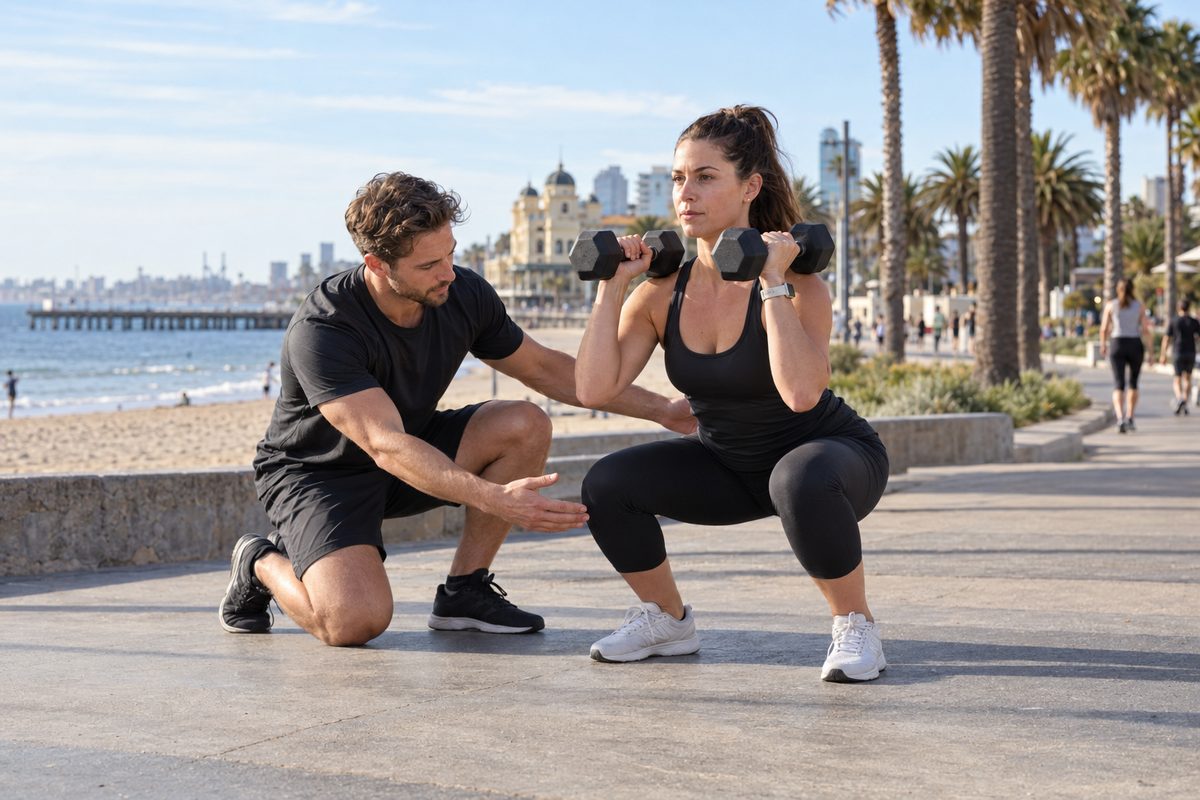
Most one-on-one personal trainers in St Kilda charge between $70 and $130 per session, and a typical weekly plan lands between $70 and $260. Small group sessions cost less per person, often $35 to $60. Online coaching costs less again. Where you land in those ranges depends on the trainer's experience, the venue, and how many sessions you book each week.
Those numbers are typical for inner-south Melbourne, not a price list. Every trainer sets their own rates. Use the ranges below to spot a quote that is far too high or too low, then ask the right questions before you pay.
What do different session types cost?
The format you pick changes the price more than anything else. Here is what I see most often in St Kilda.
- One-on-one, 60 minutes: $80 to $130. Independent trainers working outdoors sit at the lower end. Trainers with a private studio sit at the higher end.
- One-on-one, 30 minutes: $50 to $75. Short sessions suit people who train hard and want guidance on a single main lift or skill.
- Partner sessions: $50 to $80 per person. Two friends or a couple share the trainer's time and split the bill.
- Small group, 3 to 6 people: $35 to $60 per person. You still get coaching and corrections, just with less individual attention.
- Online coaching: $40 to $100 per week. You get a program, check-ins and video feedback, but no one standing beside you.
Notice that the cheapest option per hour is not always the cheapest option overall. A $40 group session three times a week costs $120. A single $100 one-on-one session each week costs less, and some people get better results from it because every rep is watched. Match the format to how much correction you need, then compare costs.
Why do prices vary so much between trainers?
Four things drive most of the gap.
Qualifications. In Australia, a trainer needs at least a Certificate III in Fitness to work with the public. That is a level 3 qualification on the Australian Qualifications Framework. Many solid trainers hold a Certificate IV in Fitness, which sits at level 4 on the same Australian Qualifications Framework and covers program design in more depth. Trainers who go further, with a degree in exercise science or clinical exercise physiology, usually charge more. That extra cost makes sense if you have a medical history or an Injury to work around.
Experience. A trainer with ten years of results and a full client list has less reason to discount. A newer trainer building a client base often charges less and may give you more flexibility. A lower rate is not a warning sign by itself. A lower rate with no insurance or no first-aid certificate is.
Venue. Where you train sets a floor under the price. A trainer who rents a private studio passes that rent on to you. A trainer who works outdoors has fewer costs. A trainer who works inside a commercial Gym pays for floor access and builds that into the fee.
What is included. Some trainers bill only for time on the floor. Others include a written program, messaging support between sessions, food guidance and progress checks. Two quotes that look different may cover different things.
What does Pricing look like for a gym membership plus a trainer?
This catches people out. If your trainer is based inside a gym, you often pay two bills: the membership and the training fees. In Melbourne, a standard gym membership usually runs from around $15 to $30 a week. Add four sessions a month at $90 and you spend roughly $360 for training plus $60 to $130 for the membership.
Some gyms bundle both into one price. Others let outside trainers use the floor for a rental fee, which the trainer then charges to you. Ask this one question before you sign anything: "What is the total weekly cost, including everything I need to pay to walk through the door?" A clear trainer answers in one line.
Does training outdoors cost less?
Often, yes. Trainers who run sessions on the foreshore skip the cost of renting a room. They also tend to keep equipment light: bands, kettlebells, a suspension trainer and your own body weight.
One of my clients, a woman in her forties who worked long days in the city, moved from a studio to outdoor sessions near Catani Gardens to save money. Her weekly cost dropped by about $25. She told me the real surprise was that she stopped skipping sessions, because a walk to the park felt easier than a drive to a studio. The money saved mattered less than the sessions she no longer missed.
There are two things to check. First, bad weather. Ask what happens when it rains and whether the session moves indoors or gets rescheduled at no charge. Second, permission. Public land in the City of Port Phillip is managed by council, and commercial trainers who use parks and foreshore areas generally need to hold the right permit. A trainer who runs sessions there openly and legally is a trainer who treats the business seriously. It is fair to ask.
Is a package cheaper than paying per session?
Usually, yes, and the discount is real. Trainers commonly offer a 5 to 15 percent reduction when you pre-pay for a block of 10 or 20 sessions, or when you commit to a weekly direct debit.
Here is how that looks in practice. A trainer charges $100 for a single session. A pack of ten sessions costs $900, which is $90 each. Over a year of weekly training, that saves you roughly $500.
Packages carry a risk, though. You are paying up front, so read the terms. Check three things before you commit: the expiry date on unused sessions, the cancellation notice required, and whether you can pause for a holiday or an illness. A package that expires in six weeks is poor value if you travel often.
My advice: start with a short trial, such as three or four sessions, then move to a package once you know the trainer fits. Paying for 20 sessions on day one of a new relationship is a bet that rarely needs to be made.
How often do you need to train, and what does that cost per month?
This is the question that turns a rate into a budget. Take the rate and multiply it by your weekly sessions.
- One session a week at $90 costs about $390 a month.
- Two sessions a week at $90 cost about $780 a month.
- One session with a trainer plus two self-guided workouts costs about $390 a month, and often delivers most of the benefit.
That last option is the one I recommend most. Many people do not need a trainer at every workout. They need a trainer to build the program, teach the technique and adjust things every few weeks. Then they train alone on other days, using the plan they were given. This keeps the bill manageable and still moves you forward.
When I started working this way with a client who wanted to lose fat, we met once a week and he followed a written plan on two other days. His monthly cost was less than half of what he had budgeted. He still reached his goal weight in the time we set, because the habit was the hard part, not the trainer's presence.
What should the price actually buy you?
A fair price pays for things you cannot easily do yourself. Look for these in any quote.
- An initial assessment. The trainer should ask about your history, your goals and any past Injury before you lift anything.
- A written plan. You should be able to see what you are working toward, week by week.
- Measured progress. Weight alone tells you little. Good trainers track strength numbers, measurements and, where it suits you, Body composition, which shows how much of your weight is fat and how much is muscle.
- Real feedback. You should leave each session knowing what you did well and what to fix.
If the price covers only a trainer counting your reps, you are paying for a timer. A timer costs nothing.
When is a cheaper trainer a worse deal?
A low rate becomes expensive when it leads to a setback. I know this because it happened to one of my clients. He had signed with a trainer charging $45 a session. The sessions were fast, loud and repetitive, with no warm-up and no technique coaching. Six weeks in, he strained his lower back doing a lift he had never been taught properly. He lost two months of training and paid for physiotherapy on top.
The lesson is not that cheap trainers are bad. Some low-priced trainers are excellent. The lesson is to judge the person, not the number. Ask to see their qualification, their current first-aid certificate and their public liability insurance. Ask how they would adjust a session if you had a sore shoulder. A confident trainer answers these questions without hesitation.
Can you get a free or discounted start?
Many trainers in St Kilda, Victoria offer a free first consultation or a discounted trial session. Take it. It costs you nothing and shows you how they communicate, how they structure a session and whether you like being around them for an hour.
Other ways to lower the cost without lowering the quality:
- Train with a partner and split a session.
- Choose a small group while you build confidence, then switch to one-on-one for a block.
- Ask for a fortnightly session rather than weekly.
- Check whether your private health cover includes any rebate for exercise physiology, which is different from personal training and does not apply to every plan.
Be careful with that last point. Standard personal training is generally not covered by health funds. Clinical exercise physiology sometimes is. If you are managing a condition, ask your fund before you assume anything.
How do you compare St Kilda with the rest of Melbourne?
St Kilda sits in the middle of the market. Prices in the central business district and in some eastern suburbs often run higher, while outer suburbs run lower. You pay a small premium for being close to the water and to quality studios, but the gap is modest. A trainer asking far above $130 an hour for standard personal training should be able to explain what the extra covers: advanced qualifications, a private space, or a specialty such as rehabilitation.
Walking distance matters more than most people think. A session that is easy to reach is a session you attend. If you live and work near the beach, a trainer based on the Port Phillip foreshore will cost you less in time and stress than a cheaper trainer across town.
Your next step
Set a weekly budget first, then work backwards. If you can spend $100 a week, you can afford one 60-minute session at a fair rate, or a small group three times a week. Book a trial with two trainers, ask each one the same questions about qualifications, insurance, cancellation and what is included, then pick the one who explains things clearly and makes you want to come back.
When you are ready to compare real options, visit St Kilda Personal Trainers and ask for a clear quote with everything listed.