Starting Personal Training in St Kilda: What to Expect in Your First Month
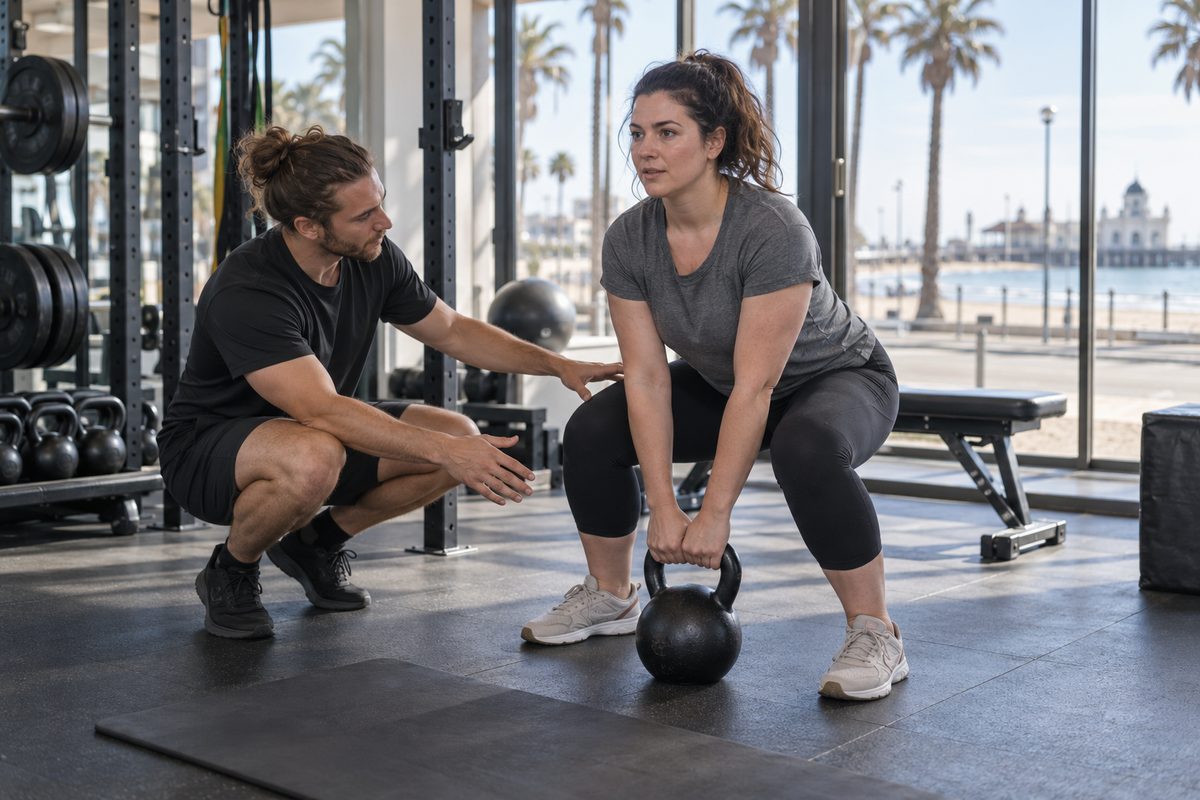
In your first month of personal training you will be assessed, taught the basics, feel sore, then get stronger, and most people see their first clear strength gains by week four. Weight change is usually small at this point. What changes fast is how you move, how you recover and how confident you feel. If you know the pattern ahead of time, you will not mistake normal early signs for a sign that something is wrong.
This guide walks through the month week by week. If you are still choosing a trainer, read our guide on personal training in St Kilda first. This article picks up after you have said yes.
What actually happens before your first workout?
A good start looks like a conversation, not a workout. Trainers call this onboarding. It is the setup phase where your trainer learns your history and you learn how the process works.
Expect questions about old injuries, sleep, work hours, stress and what you have tried before. You will usually fill in a health screen. Expect a few simple movement checks too. You might squat to a box, hold a plank, reach overhead and balance on one leg.
Your trainer may also take baseline numbers. These can include weight, a waist measurement, a resting heart rate or a basic body composition reading. Body composition just means the split between fat, muscle and everything else. It tells you far more than the scale alone, because you can lose fat and gain muscle at the same time and see almost no change in weight.
One of my clients, a 41-year-old who worked long desk hours, almost skipped the assessment because she wanted to "just get started." The movement check showed her left hip was much stiffer than her right. We fixed that in week one. Without it, her squats would have gone wrong by week three.
Write down one clear goal and one date. "Climb stairs without getting puffed by the end of the month" works better than "get fit."
What does week one feel like?
Week one is about learning, not suffering. Sessions are lighter than you expect. You will learn a small set of core movements: a squat, a hinge, a push, a pull and a carry. Your trainer cares more about how you move than how much you lift.
This is the start of strength training, and it matters that you begin with form. Early on, the weights are light on purpose. Poor technique repeated under load is how people end up injured in week five.
You may leave week one thinking, "That was easy, am I wasting money?" You are not. I know this because I have heard this exact line from many clients. By Thursday the same people usually message me to say they can feel muscles they forgot they owned.
Your job in week one is simple. Turn up, ask questions and sleep well.
Why are you so sore in week two?
Soreness peaks in week two for most beginners. It has a name: delayed onset muscle soreness, or DOMS. It shows up 24 to 72 hours after a session, and it can make stairs and toilet seats feel like a bad joke.
DOMS comes from unfamiliar effort. Your muscles are doing work they have not done before, mainly the lowering part of a lift, like sitting down into a squat. The tiny disruption this causes is not damage in a worrying sense. It is a normal sign that your body is adapting.
Here is what I tell clients. Soreness is not a score. A session that leaves you barely sore can still be a good session. And chasing soreness every time is a poor plan, because it makes you skip the next workout.
What helps:
- Walk the next day. Gentle movement keeps blood flowing and eases stiffness.
- Eat enough protein and drink water through the day.
- Sleep seven to nine hours, because that is when repair happens.
What does not help is stopping completely. When we rest too long, the soreness comes back at full strength after the next session. Light movement beats a week on the couch.
Pain is different. Sharp pain in a joint, pain that gets worse during a lift or pain on one side only should be reported to your trainer straight away.
What is changing inside your body during these weeks?
The biggest early change is not muscle size. It is wiring. In the first few weeks your nervous system learns to recruit the muscles you already have. The link between a nerve and a muscle fibre is called the neuromuscular junction. It is where the nerve signal tells the muscle to contract. With practice, this connection gets faster and more efficient.
That is why you can add weight to the bar in week three without looking any different in the mirror. You did not grow much muscle in 14 days. You got better at using what you have.
Your heart and blood vessels adapt as well. Your circulatory system gets better at moving blood to working muscles, so the same effort feels less harsh. Many clients tell me their resting heart rate drops and their breathing settles faster between sets.
Put together, this is early physical fitness. It is the base that makes harder training possible later. It also explains why motivation often jumps in week three. You are not imagining it. Your body really is getting better at the work.
How does training get harder in week three?
In week three your trainer starts to push. The method is called progressive overload. It means doing slightly more over time: a little more weight, an extra rep, a slower lowering phase or a shorter rest. Your body only adapts if the demand rises.
A good trainer raises one thing at a time. If your squat goes from 10 kg to 12 kg, the reps and tempo should stay the same. This keeps form clean and makes progress easy to track.
Here is a real example. One of my clients started with a 6 kg goblet squat. By week four she was holding a 12 kg dumbbell for the same ten reps with better depth. She had not lost any weight on the scale. She had doubled her load. That is the kind of result to measure.
Ask your trainer to keep a training log. If every session looks the same on paper, progression is not happening. A program without clear overload is just exercise.
What changes by week four?
By week four, most people notice changes that have nothing to do with the scale. Stairs feel easier. Groceries feel lighter. You stand taller. Clothes may fit differently around the waist or shoulders.
Your trainer should repeat the baseline tests from week one. Compare them. Did your plank hold get longer? Did your resting heart rate drop? Can you lift more with the same form? These numbers show real progress when the scale does not.
Be careful with weight. Early on, water and food volume move the number up and down by a kilo or two. Body composition can shift even when weight stays flat. If you are only watching the scale, you can miss real change. Use three signals together: strength, measurements and how you feel.
Expect a check-in at the end of the month. This is where your plan gets updated. A good trainer will tell you what worked, what did not and what the next block looks like. If nobody mentions a review, ask for one.
Does training outdoors help in St Kilda?
It can, and it is a St Kilda advantage that many people overlook. Your trainer may take you out of the studio for walks, intervals or mobility work. Catani Gardens is a popular option because it has flat paths, open grass and sea air close by.
Outdoor sessions add variety, and variety keeps people coming back. They also give you easy cardio on days when your legs are sore. A brisk walk along the foreshore in week two is one of the best recovery tools you have.
Do not let the setting replace the plan, though. A session in Catani Gardens should still follow the same structure as a gym session: warm-up, main lifts, a finisher and a cool-down. Beautiful scenery is a bonus, not a program.
If you live or work in St Kilda, Victoria, convenience matters more than most people admit. A trainer who is ten minutes away will see you more often than one across the city. I have watched good plans fail purely because of a bad commute.
What mistakes ruin the first month?
Three mistakes are not the problem here. Two are. Each one is common and easy to avoid.
Doing too much between sessions. New clients feel good in week one, then add three extra gym visits on their own. By week two they are exhausted and sore. Stick to the plan your trainer gives you.
Ignoring food and sleep. Training is the signal. Recovery is where change happens. One of my clients trained hard for three weeks on five hours of sleep and wondered why she felt flat. When she moved bedtime earlier by one hour, her numbers jumped within ten days.
You will also hit a bad day. Everyone does. A session where the weights feel heavy is normal, and it does not mean progress has stopped. Show up anyway and do a lighter version. Consistency in the first month matters more than any single workout.
Your next steps
The first month is a ramp, not a test. Start gently, learn the movements, expect soreness, then push a little harder each week. Here is exactly what to do:
- Before session one, write down your goal, your date and any past injuries.
- Ask your trainer to record baseline numbers for strength, body composition and resting heart rate.
- Book at least two sessions a week for the first four weeks and walk on the days between.
- Keep a training log and check that the numbers move up.
- Book a review for the end of week four and repeat your week-one tests.
Do these five things and you will finish the month with proof that the work is paying off. That proof is what keeps you going into month two.