Outdoor vs Gym Personal Training in St Kilda: Which Suits You Best?
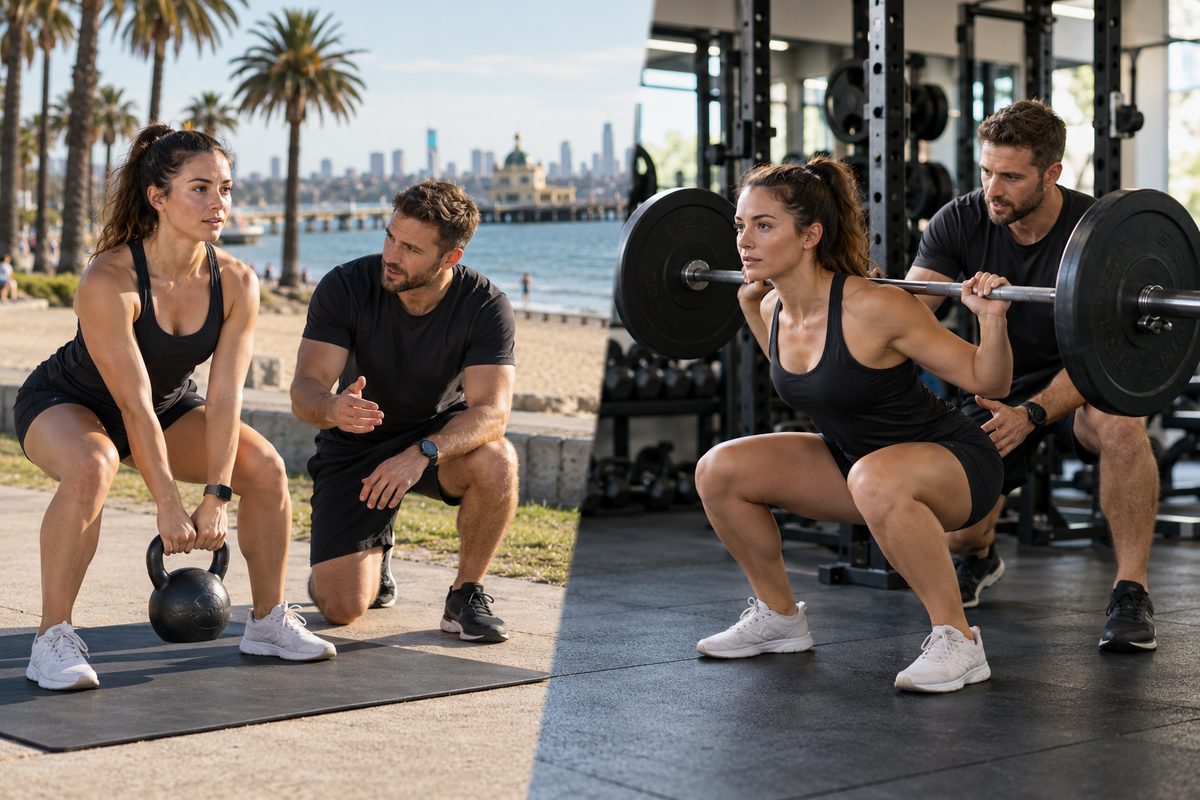
Choose a gym if your main goal is building muscle or lifting heavy, and choose outdoor training if you want fitness, fat loss and a session you will actually show up for. Both settings work. The better one is the one that matches your goal, your schedule and how you feel on a cold Tuesday morning. Here is how to decide without guessing.
I have trained clients on both sides of this question. Some did their best work in a quiet studio with a rack and a barbell. Others only got fit once we moved to the beach path. The setting changed their results because it changed their habits.
Which setting builds muscle faster?
The gym wins for Muscle hypertrophy. Growing muscle needs enough load, enough volume and a way to add weight over time. A gym gives you barbells, cable stacks, leg press machines and heavy dumbbells. That makes it easy to train each muscle close to failure with a weight you can measure.
This is where Progressive overload matters. Progressive overload means you ask your body to do slightly more than last time. That could be 2.5 kilograms more on a squat, one extra rep, or a slower lowering phase. In a gym, you write the number down and beat it next week. Your body then has a reason to grow.
You can do this outdoors, but it is harder. Outdoor kit is usually bands, kettlebells, a sled, a suspension trainer and your own body weight. A push-up is a fine exercise, but once it gets easy, you cannot add 10 kilograms to it with a click of a pin. You have to change the leverage, slow the tempo or add reps. That works, but it takes more planning.
One of my clients, a 34-year-old who wanted to add shape to his shoulders and legs, spent two months training outdoors. He got fitter and leaner, but his lifts stayed light and his size barely changed. When we moved his main lower and upper body work indoors, his squat went up by 20 kilograms in eight weeks. I know this because I tracked both blocks side by side. The outdoor block was not wasted. It just was not built for his goal.
Which setting builds fitness and Endurance better?
Outdoors has the edge for Endurance. Real conditioning comes from continuous effort, and outdoor spaces make that natural. A 20-minute circuit that mixes sprints, carries and hill runs lifts your heart rate in a way a set of machine reps never will.
The outdoors also adds variety you cannot fake on a treadmill. Wind pushes back. Sand shifts under your feet. The ground is never perfectly flat. Your ankles, hips and core do extra work without you noticing. Many people find that a session that feels moderate in the moment leaves them far more tired than the same effort on a machine.
When we run outdoor blocks for clients who want to lose fat, the numbers tend to follow the same pattern. They train with a higher heart rate for longer, they finish the session, and they repeat it the next week. Fat loss comes from that repeatable effort and from what happens in the kitchen, not from the perfect program.
A gym can still build Endurance. Rowers, bikes and sled pushes work well. The difference is motivation. Most people find it harder to hold a hard pace alone on a bike indoors than to run toward a lamp post a trainer just pointed out.
What does each option really cost?
The Cost question is not as simple as the sticker price. Think in two parts: the trainer fee and the place you train.
With outdoor training, you pay for the trainer and usually nothing else. The park, the path and the beach are free. Trainers who run outdoor sessions carry their own equipment, so they have no gym rent to cover, and that often shows up in a lower hourly rate or a cheaper small-group option.
With gym training, you may pay for the trainer and also for access. Some trainers work inside a gym that charges them a floor fee, and that cost can pass to you. Others expect you to hold your own membership. Studios that are private and equipped with premium kit often cost more again, but you get a controlled space with no weather to worry about.
If Budget is tight, here is my honest read. A small outdoor group session is usually the cheapest way to get coached training. A one-on-one session in a private studio sits at the other end. A one-on-one session in a shared gym sits in between. Ask each trainer for the full cost per session, including any facility fee, before you book anything. Then compare the price per session over a month, not just the first visit.
Also count what you save. If outdoor training means you cancel a separate gym membership you barely use, your real spending drops. If you already pay for a gym and use it well, adding a trainer there may be the cheapest upgrade you can make.
How does St Kilda's weather and Terrain change the decision?
St Kilda, Victoria is one of the best places in Melbourne to train outdoors. The foreshore is flat and long. That suits running intervals, loaded carries and tempo work. The pier, the stairs and the sea wall give you short climbs for leg power. Catani Gardens offers soft grass, shade and open space for strength circuits, and it is quiet enough early in the day to run a full session without crowds.
Nearby, Albert Park, Victoria adds a different challenge. The lake loop is a clean, measured route for steady running, and the surrounding paths let you plan intervals with real distances. If you like data, a fixed loop gives you a simple way to see progress. You ran it in 28 minutes last month and 26 now.
The Terrain matters more than people expect. Sand and grass are softer than concrete, which is easier on joints but harder on the legs. Running on sand can use far more effort than running on a path at the same speed. That is useful for fitness, but it can strain calves and Achilles tendons if you jump in too fast. A good trainer will ease you in.
Weather is the real test. Melbourne can give you four seasons in one afternoon. A strong bay wind or a cold winter morning can turn a good outdoor plan into a bad one. Heavy rain, heat above 35 degrees and lightning mean a gym backup is needed. Ask any outdoor trainer what happens when conditions turn. If the answer is that you simply cancel, that is a risk to your consistency.
In my experience, the best outdoor trainers keep a fallback plan, such as a covered space or an indoor studio. That way a bad forecast changes the venue, not the session.
Which one will you stick with?
This is the question most articles miss. The best program is the one you finish. A perfect gym plan does nothing for someone who dreads the building. A fun beach session does nothing for someone who hates being watched in public.
One of my clients, a woman in her forties, joined a gym three times and quit each time. The noise, the mirrors and the crowds drained her before she lifted a thing. When we moved her to a quiet morning session near the water, she did not miss a week for five months. She did not change her motivation. We changed the room.
Another client was the reverse. He felt exposed outdoors, and the wind made him self-conscious about his form. In a private gym, he relaxed, lifted heavier and made faster progress. This is just based on what happened to my clients, but the pattern is clear: comfort drives consistency, and consistency drives results.
Ask yourself two blunt questions. Where do I feel calm enough to push hard? And where will I turn up when I am tired? Your honest answers beat any pros and cons list.
Who should pick outdoors, and who should pick a gym?
Pick outdoor training if you:
- want to lose fat and improve fitness more than build size
- get bored indoors and need variety to stay motivated
- have a tight budget and want coached sessions without extra fees
- enjoy fresh air and find it lifts your mood and energy
Pick gym training if you:
- want to build visible muscle or increase your strength numbers
- need heavy loads for sports or injury rehab
- dislike weather risk and want the same session every week
- prefer privacy and a controlled space
Some goals sit in the middle. If you want to feel stronger, move better and drop a few kilograms, either setting can get you there. In that case, choose by comfort and cost, then lean on a good coach to make the program count.
Can you mix both?
Yes, and for many people this is the smartest choice. A simple split works well. Do one or two heavy strength sessions in a gym each week, and one or two outdoor conditioning sessions near the water. You get the loading you need for muscle and the conditioning that only outdoor work delivers.
This mix also protects you from boredom and from bad weather. If the forecast is poor, you swap the days. Nothing is lost. When we built this kind of week for a client who wanted to drop 8 kilograms and keep her strength, she hit her target in about four months and kept her lifts climbing the whole time.
If you mix settings, tell your trainer. The program should link the two, so your outdoor sessions do not leave your legs too tired for your gym lifts. Good planning puts the hardest strength day away from the hardest conditioning day.
What should you ask a trainer before you decide?
Whichever setting you pick, ask four things before you commit. How will you track my progress? What is the total price per session? What is the plan when the weather turns? And how do you handle progression once an exercise gets easy?
The last question tells you the most. A trainer who answers with specific numbers, such as adding weight every two weeks or lengthening a run interval by a minute, understands how to build results. A trainer who says they will keep things challenging probably has no system.
You can find a longer guide to vetting a coach in our article on choosing the right trainer for your goals. If you are about to begin, the first month article explains what to expect from the early weeks, including the soreness that catches most people off guard.
Your next steps
- Write down your main goal. If it is muscle or heavy strength, lean toward a gym. If it is fat loss or fitness, lean toward outdoors.
- Set your weekly budget. Ask every trainer for the full price per session, including any facility fee.
- Book one trial in each setting. Do a session in a gym and one outdoors near the foreshore or Catani Gardens. Notice where you push harder and where you feel more relaxed.
- Pick the setting you will attend in bad weather. Commit to it for eight weeks and track one number each week.
- Ready to start? Talk to the coaches at St Kilda Personal Trainers and tell them your goal. They will point you to the setting that fits it.